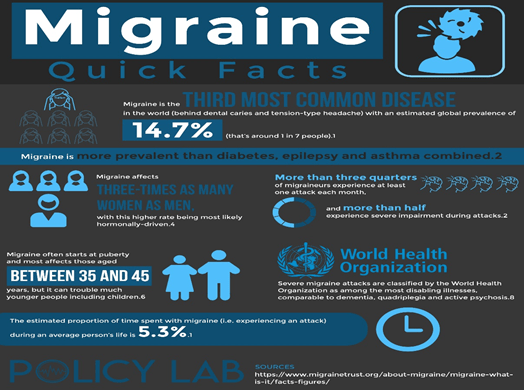
Migraines are occurring more and more in many different people. There is a lot of research and information available, however, many people still think of a migraine as a bad headache. It is much worse than that! I will use my experience to try and dispel this myth.
Almost all of my attacks don’t start with a headache, that comes much later, usually 3-4 hours after the initial symptoms. Migraines can be split into four parts: prodromal which can start up to two days before the attack; aura, which leads into the third phase the main headache and finally the resolution where recovery begins and feelings of tiredness occur.
Most of my attacks start with a visual disturbance. This can be a number of ways. A small light, like a hole which grows gradually so vision is difficult. A second way is a flashing coloured circle which, again, grows and moves across my vision, a third, similar way is a ‘c’ shape of coloured light which again grows and moves across my vision. And finally there can be disruption to my sight particularly through one eye where objects can’t be seen clearly, only in part. All of the above make it extremely difficult to see clearly or to focus on anything. At this point I have to go to a darkened area, close my eyes and lie down until I can see clearly again. This usually lasts for around 30 minutes.
The next stage is a tingling or numbness in the fingers and arm. It can start like ‘pins and needles’ and travel up my arm. This can start anything up to twenty minutes after sight has been restored and can last for around fifteen minutes. Trying to do anything that needs touch is very difficult and uncomfortable. Occasionally this spreads to the face, in particular the tongue, where it feels swollen.
After the tingling and numbness comes a feeling of not being able to speak clearly. It appears like slurred speech and sometimes as though not saying words properly. It can also feel like I’m not saying a word at all and at times I find it difficult to get the right word to say. This makes life difficult when in meetings or even trying to have a conversation.
The final phase of the ‘aura’ affects my memory. I find it difficult to remember names in particular. This has caused problems when speaking to people and not being able to remember their name. So from not being able to talk to someone properly and then not remembering their name, it can all become very embarrassing, annoying , frustrating, and, of course, amusing, when with the right people!
The whole ‘aura’ can last up to three hours, with a short space of time between each phase. Not every attack follows this pattern or has all of the ‘auras’ described. Most start as visual disturbance. After the ‘aura’ the headache starts.
The headache can be of different types and in a different place. Pulsating, throbbing or a constant pain. Usually near one eye or on one side of he head. The intensity of the pain also varies. Movement is difficult and painful, sitting still or lying down is the easiest and most comfortable. Do not cough! Patience and concentration are very low. This can last between forty eight and seventy two hours, easing slowly as time goes on.
As the pain decreases then the resolution phase starts. Many things can happen at this stage. Hunger, especially craving sweet things, biscuits, cakes. Depression, feelings of not being worthwhile or being a burden, and becoming very emotional over the least thing. An intense tiredness, just wanting to sleep and having no energy or motivation to do anything at all.
Including all four phases, a full attack can last up to five days before being able to do all activities fully. This doesn’t happen every time as every attack is different. However, every attack does affect life. Time at work, with family, doing hobbies and sport are all affected. Trying to do things too soon, not recovering fully also affects me. Many times I have not fully recovered only to have another attack within a few days.
Trying to predict when an attack will happen is difficult. There are many triggers, but they don’t always lead to an attack. The main triggers for me are anxiety and stress, lack of good quality or interrupted sleep, sometimes food can lead to an attack especially cheese and chocolate. I do have to be careful with oranges. Red wine is also a big trigger. Doing too much exercise with insufficient rest can also start an attack. The strangest triggers are bright sunlight and the colour red! At times I have expected and attack because one or more of the triggers have been present, and nothing occurs. At other times I have felt calm, fit and well and have been surprised by the onset of an attack, leaving me bewildered, confused and upset.
My first attack happened as a teenager, over forty years ago, and I still remember it clearly. During that time I have tried many things, keeping a diary of attacks, keeping a food diary, many different types of medication – herbal as well as prescribed. Nothing has stopped attacks happening. All have had some effect for some time. There has been nothing that takes away the pain or makes it easier to live with. Medication has included tablets taken daily or at the start of an attack. They haven’t lessened the effect of the attack or stopped it. The only thing that seems to work is to rest, stop doing all the things I enjoy and wait for it to clear. In an ideal world it would be good to lock oneself in a cool, dark room for the duration but, of course, with work, family and other commitments this is not possible. I still record attacks, I use an app called ‘Migraine Buddy,’ this is a useful app has it also has a lot of information about migraines and tips for how to live with them.
 Man on a bike.