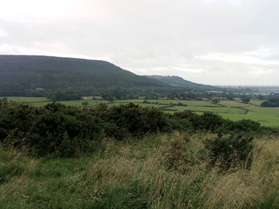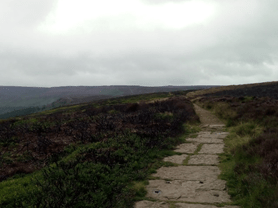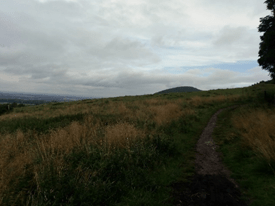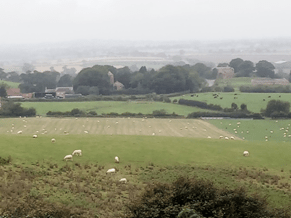
Reeth and Arkengarthdale.

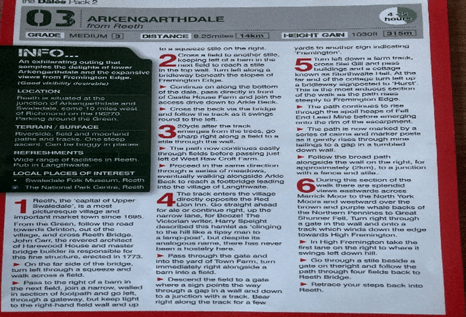
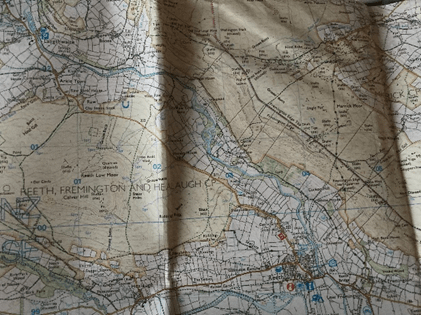
Yorkshire Dales OL 30 OS explorer map
The Dales pack 2 cards 

For this walk I used the Yorkshire Dales OL 30 OS explorer map and ’The Dales Pack 2’ walk cards.

This is the third time I’ve completed this walk. The other times, I did one clockwise the other anti-clockwise. On this occasion I decided to go anti-clockwise. The man reason for this was that the climbing and high level part of the walk came at the beginning. I felt it was better to attempt this while I still had the energy rather than in the second half when I was getting tired, but also re-starting after having  a lunch break is never easy, and the village of Langthwaite is the natural half way lunchtime point. So, using the ‘Dales Pack’ cards  and OL 30 Yorkshire Dales, Wensleydale and Swaledale map I set off from High Fremington. At the end of the walk I stayed on the bridlepath back into High Fremington rather than turning off at a gate down through a field into Reeth as it shows on the Dales pack card.

Today Reeth is the main town in upper Swaledale, but this wasn’t always the case. In Norman times, up until the leadmining times of the 18th and 19 centuries, when Reeth became an important service centre for the mines and smelt mills, it was Grinton, further along the road. Some of the inns and hotels can be traced back to pre-leadmining times.

                There is parking in Reeth itself but I was able to find space set back from the road at the edge of Low Fremington, other cars were also parked there, no ‘No Parking’ signs or yellow lines, so I felt settled leaving it. The gives a length of around 8¼ miles and a time of 4-5 hours. With a few photo stops, talking to bike riders and other walkers, and a packed lunch in Langthwaite, I was back at the car in just 4¼ hours.

                The start is very daunting; steep and difficult underfoot, rising to around 400m.  It starts on the road, narrow, tricky and steep up through Fremington. As it reaches houses there is the choice of a steep off road path or stay on the road. I stayed on the road, which turned out to be the better choice as it was smoother going and not as steep. The paths meet at a bridleway. This was the way I returned. Stay on the road as it continues uphill and through Intake Wood. As I walked up this part I was passed by a cyclist and then a car. The car stopped at a house further up the hill, just as the smooth road stops and the rugged, stony path begins. It made me think about how they managed in depths of winter, trying to get up here when the road is covered in snow, or maybe the people there at the moment were using it as a holiday home. At times there was the opportunity to walk on the grass, this came as a big relief from the loose stones and holes in the path.
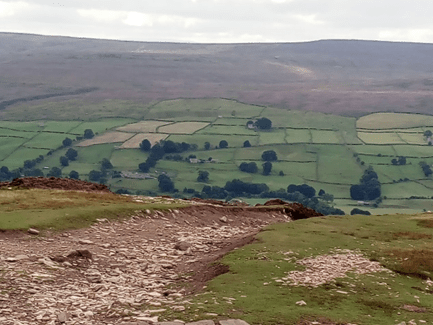
The tricky uphill path

Looking up ahead, I noticed the cyclist had also found the terrain difficult and had got off his bike and started walking.
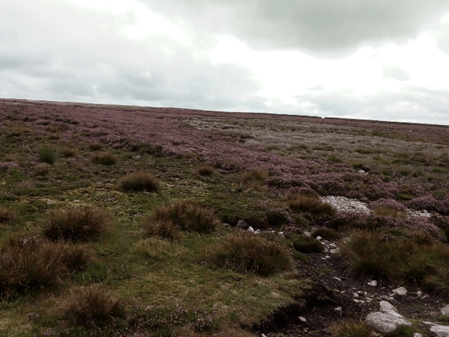
Lonely on the moor top.
Just a few sheep for company.

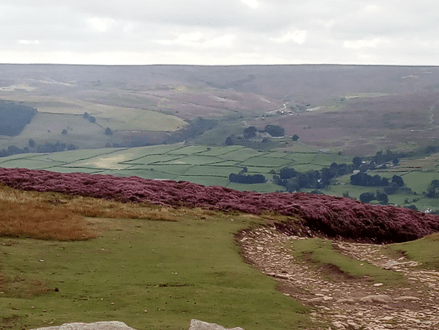
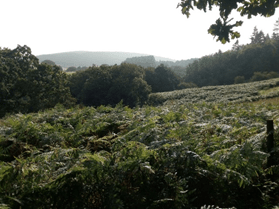
                Along the path there are plenty of places in which to stop and take in the view back across the valley beyond Reeth to the fell tops of Reeth Low Moor and Harkerside Moor. These places could also be used as photo opportunities, or, resting places! The man on his bike had stopped in order to make the most of one of these spaces. He was still there when I reached him, so I stopped and had a chat, it would have been rude not to! The bike he was using was rented from the centre in Grinton and motorised. He told me it helped on the smoother parts of the track but was still tricky on the lumpier loose stones. As were talking another cyclist approached, carefully picking his way through, but not stopping. He had an amazing pedalling rhythm and was working hard to maintain it, his eyes fixed on the path. We both looked on in admiration. I made my goodbyes and wished him luck with the remainder of his journey, and continued up the hill, reaching the summit shortly afterwards. At the top there was a gate through a wall, giving the choice of staying in the area I was standing in or walking to the other side of the wall. I decided to go through the gate. For me this seemed the better path as I was able to get really good views back over Reeth again but also across this moor, Marrick moor, towards Helwith and Marske.

                Through the gate it is a left turn, following the wall with fells and moors all around, only sheep for company. However, on the other side of the wall there were some groups of walkers making their way towards the hill I had just climbed. Along this path, a walk of around a mile, with spectacular scenery all around, until breaking off left through a gate towards the spoil heaps left from the old lead mines. It is thought that at one time this area was producing 10% of the country’s lead. The history of lead mining in this area can be traced back to the 2nd century BC and reached its peak during the 18th and 19th centuries.
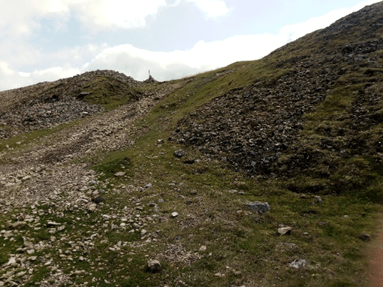
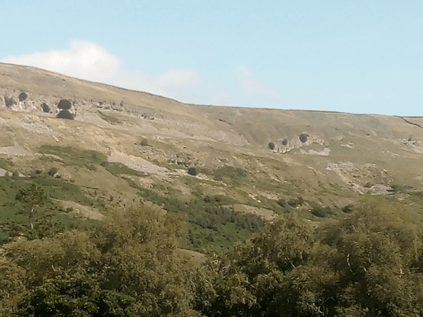
Down through the lead mining spoil heaps.
Looking up onto the moortop.

                The path is now much wider, and downhill, with the village of Langthwaite in the valley bottom. About halfway down the path takes another left turn, giving the opportunity to look back across the valley to Reeth, now in the distance. From here the path follows the bottom of the cliff, becoming narrower with loose stones underfoot. It emerges at Storthwaite Hall, which, in the early 19th century was a small hamlet in the township and Parish of Reeth. Then over the stream, take a right and, after a few yards, left, back uphill, through a field towards the small settlement of Booze, described as, ‘clinging to the hill like a tipsy man to a lamp-post’ by the Victorian writer Harry Speight. The path goes through a farm then joins a smooth road, the smoothest part of the whole walk! The road goes all the way downhill into Langthwaite. Just after leaving the farm I stopped to watch a kestrel flying close by, eventually landing on a telegraph pole, watching me watching it. So, another descent. I much prefer going uphill, I find descending, regardless of the surface, trickier, especially on the front of the thighs and knees. The entry into the village at he bottom is very steep. I had already decided that I would have lunch in Langthwaite, so, with aching thighs I was glad to find a bench next to the river, and have lunch.
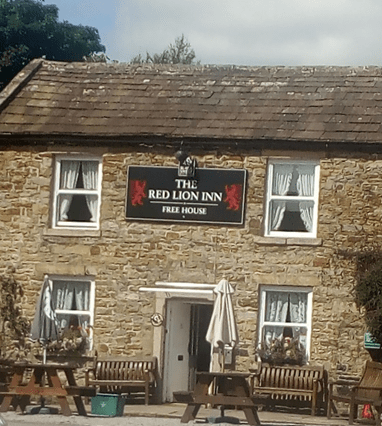
The Red Lion Inn  at Langthwaite.

                Langthwaite is one of the Yorkshire Dales’ lesser known hamlets, a few miles north of Reeth. Its name is old Norse for ‘long meadow or clearing’, which seems accurate as the small settlement hugs the beck after the wild moor. The Red Lion inn was often seen in the original ‘All creatures great and small’ tv series along with the bridge that leads into the hamlet. It would have been a lot busier during the lead mining times.

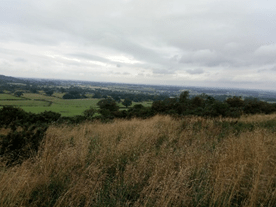
                It was also the end of the first half of the walk and where the change in landscape started. The first half was high level fell and moorland, with spectacular views across them and into the valleys. The second half was to be low level along the valley following Arkle Beck. Views would be mainly of the fields, over and back up to Fremington Edge, looking at the way I had walked. It was surprising how high it looked from down in the valley bottom. I was able to pick out landmarks from where I had been walking earlier. I also got  a different perspective of the spoil heaps and how they had altered the landscape.

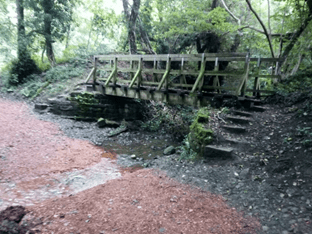
After a fifteen minute rest for a sandwich and drink, I started out again, following Arkle Beck away from Langthwaite. It is a walk down another stony path until reaching a bridge, a very narrow bridge, one foot at a time to cross. Looking up and down the beck it is dark as the trees almost meet in the middle, letting little light through. Across the bridge, then left and follow a very narrow path alongside the beck, being careful not to trip over the many tree roots sticking out. The river wasn’t deep but I couldn’t see any fish swimming, they’d probably seen me first. The path eventually leaves the riverside and goes across fields. From the fields, through the trees, it is possible to see Fremington Edge very clearly, and the route I took, seeing the face of the hills. This section continued across a series of fields until it eventually meets a narrow lane.

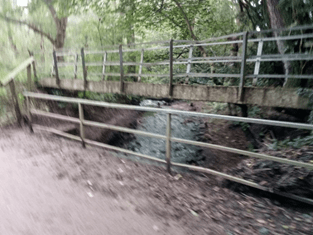
At the lane turn left and back down to the river through a gate. After the gate, following the road to another bridge crossing the river. This bridge is much wider than the one back in Langthwaite, but the views up and down the river are just as interesting, but not as dark! Crossing the bridge the road goes through another gate and uphill, the longest and steepest, climb of this second half of the walk. It widens as it heads up to castle Farm. Bringing me back to the reality of the day was  a sign on the gate to the farm at the top of the hill, telling walkers to go round the farmhouse instead of following the path through as the people living there were isolating from the COVID pandemic!
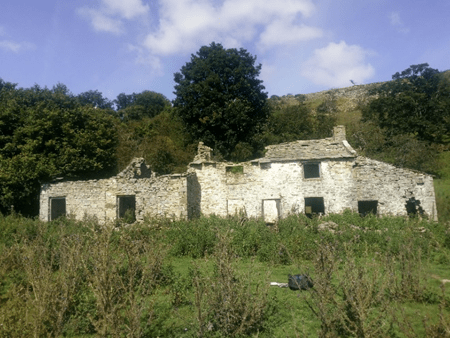
What is the story that goes with this house?

After going round the farmhouse the path is now above Arkle Beck and moving further away from it, going through fields and only slightly undulating. Passing through one of the fields, I notice a very interesting ruin, which certainly gets the imagination working overtime. It is a farmhouse, almost all intact, the doors and windows can be made out easily, as can the gar den gate and path. Inside, the buildings are overgrown and the only inhabitants are sheep, unless at night the ghosts of the families that lived there re-appear! With those thoughts in my head I quickly moved on.

From here the path continues to twist and turn with ups and downs, slippy in places where the sun hasn’t dried up the patches of mud. It eventually comes out onto a bridleway. The walk on the card turns right through a series of fields, some with cows in, a sign warning walkers about this. I had already decided to continue on the bridleway as it meets the steep stony path I walked up at the start. This path stays on the same level, is grassy and wide. From here the village of Reeth comes back into view. It also runs parallel with the road out of Reeth to Fremington where I had parked the car and started the walk. As well as looking down onto Reeth I could look up and follow the path I had climbed three and a half hours earlier.

Reaching the end of the bridleway, returning to the road, I had those mixed feelings, knowing that all the hard walking was done and I could look forward to a rest, drink and hot shower, but also knowing it was back to reality, my escape into the country, peace and quiet, over. From here it was back down the road. I decided to take the narrow path between the houses, the one I ignored at the start. This was steep, very slippy and uneven. I was pleased I hadn’t walked up it earlier. At the bottom it was onto the road, down the hill and back to the car.

There are places to eat and drink in Reeth ranging from tearooms to pubs and hotels. Eleven miles further away is the larger town of Richmond with a wider variety of eating and drinking places, however it would be a shame not to experience fully this jewel in the heart of Swaledale.
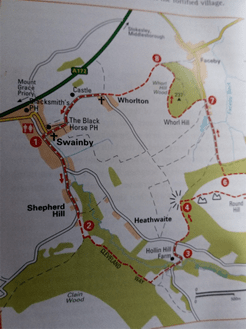
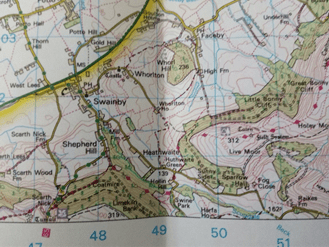
A walk round Swainby N.Yorks.

A circular walk from Swainby.

A walk taken from ‘AA 50 Walks in North Yorkshire.’ This is walk number 22. I also used the OS landranger map 93.

The walk is a mixture of road, bridleway and footpath. It goes through woodland, moor and fields. It is undulating with two steep climbs and descents. Throughout there are amazing views over moorland and it follows part of the Cleveland Way.

On the day I walked the weather was a mixture of cloud, some short showers with sunny spells. The book gives a minimum time of 3 hours, other than stopping to take a few photographs and a slight unexpected detour (I missed a footpath sign!) I managed to complete it in just under the 3 hours.

                The walk starts and finishes in Swainby, North Yorkshire. A small village just off the A172 near to Stokesley and Middlesbrough. Along the way it passes near two other villages, Faceby and Whorlton. Parking is on the roadside but there are plenty of available spaces and it is free.

                Swainby emerged as a village after the Black Death of the 14th Century when the villagers of nearby Whorlton left to excape the disease. It then grew with the influx of workers to the ironstone mines in Scugdale during the 19th Century as well as the jet mining on Whorl Hill. All that remains at Whorlton is the castle and church, both partly in ruin. Faceby was mainly an agricultural area and part of the Parish of Whorlton. Its name could originate from the old Norse meaning ‘Feit’s settlement.’ There is a 12th Century church, St Mary Magdeline.

When leaving the village walk with the stream  on your left, along the raod towards the hills. This starts to go uphill, before it gets too steep take a path going slightly left towards Clain woods. There was tree felling, clearing parts of the wood near the path. These were clearly signed making it safe. It also helped as the path I needed could have been easily missed. This is a narrow path leading through the woods following the Cleveland Way.

Through the trees there are clear views . Along this path I met another walker, going the opposie direction, two dog walkers and two young lads running. A busy morning! The path was a little muddy, there having been a lot of rain the previous day. It was also slightly undulating, but nothing too strenuous or difficult.

                You leave this path through a gate just past a bench. It goes downhill through a field. I did notice signs warning me of a bull in the field. I could see the cattle at the far end of the field, far enough away for them not to notice me. However, I did still play the game of, “Which one is the bull?” as well as checking the field for the quickest escape route when it does see me.

                Leaving the field at the bottom corner, I came out at Scugdale Beck with two bridges going over it and joined the road. This area is sheltered and hidden in the trees, and very scenic!

The walk follows the road past Hollin Hill farm to a ‘T’ junction at Husthwaite Green. Cross over the road back into the woods. This is the start of a long, and at times, steep climb. It is a mixture of path and steps. As it goes up there is an amazing view looking back towards Swainby and beyond, the traffic on the nearby A172 and A19 looking like toy cars.

After the viewpoint it is steep walk up through the woods. Continue through a gate and up to the moor top following the path flanked by bracken. This path goes up over 300m, looking down onto the woods of Little Bonny Cliff and Great Bonny Cliff.

West Bilsdale East Bilsdale

Emerging out of the woods and bracken and across the heather, past two cairns finally reaching the top there are views to the west, again back to Swainby and beyond but also to the east and Bilsdale. A chance to see the contrast between the hills and moors on the eastern side and the fields, roads and villages to the west. Along the path comes the next potential missed turn.

                Looking for a small path on the left to take me down back through the heather and bracken to the edge of Little Bonny cliff woods. Luckily I found it rather more easily than I expected. Take the path down to the edge of the woods, this is much easier as you can’t go any further when you reeach the woods. Turn left at the fence and follow it, and the edge of the woods, until reaching a gate. Walking along this path as if walking to the path that took me up to the top of the moor, in a small circle. I couldn’t help wondering why I’d climbed all the way to the top to just come back down and round! It’s a walker’s thing!

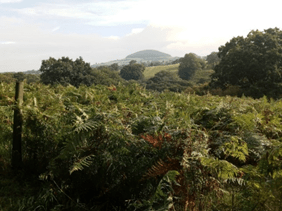
After going through the gate the path falls steeply downhill. This is a tricky descent through the trees, the path being muddy and slippy, and having to negotiate tree roots and fallen branches. Once at the bottom its throught the gate and down the wide path walking away from the woods and on towards Faceby at the bottom of Whorl Hill. Whorl Hill is easily recognisable by its dome shape, standing away from the main hills and woods. Legend has it that the hill is the home of a wyrm dragon which had toxic breath and breathed fire, regulalarly flying across and destroying the farmland and crops. The way to keep it calm and quiet was to feed it the milk of nine cows each day. It was eventually slain by a knight who was passing through Whorlton. His name was never discovered and, to this day, is known as the unknown knight!

                This is the part of the walk where I made my biggest mistake, missing the footpath to take me into Whorl Wood. Thinking it was in the village of Faceby I walked straight past it, distracted by   (my excuse!) a farmer cutting his hedges! After wandering round Faceby for around 15 minutes I decided to re-trace my steps back towards the woods where, as it said quite clearly in the book, I found the ‘First house on the left!’

                This path leads to the next and final steep climb. It goes straight up through the woods keeping their edge on the left. It is a tricky, but short climb that heads off onto a wide path through the woods, with occasional glimpses through the trees back across the moor.

                Walk through the woods unitl the path comes to a ‘T’ junction then turn left, this path going back downhill, reaching a further path and passing through a pair of gates. As you follow this path you begin to see the church and castle of Whorlton.

In the distance,Whorlton Church and castle

Whorlton Church dates back to the 12th Century. It is dedicated to the Holy Cross and was known as the Church of the Holy Rood up to the Reformation. Inside is a large oak effigy of Lord Nicholas de Meynell of Whorlton Castle who died in 1322. The church was used for the last time on 7th March 1875 although occasional services are still held there. The castle, just along from the church, was probably built by Robert de Meynell around the 12th century and was an earth and timber Motte and Bailey. By the mid 14th Century it had fallen into disrepair and was demolished, being rebuilt with a new stone tower and fortified gatehouse, this being all that remains today.

During the 19th Century large amounts of stone were removed and used to build Swainby village church.

The path continues past a farm and through fields. It was particularly tricky as a lot of nettles were beginning to stray onto the path. Wearing shorts turned it into a game of trying to avoid the nettle sting! Thankfully I got through unscathed. This is the last of the footpaths as you reach the road at Whorlton church then it is roads all the way back past the church and castle, into Swainby. Unless, like I did, take a small path on the edge of the village which takes you round the back of the cottages, past a playing area and emerges at the Black Horse pub. If you stay on the road you get to see more of the village, in particular the old school house. The buildings along Church Lane are very interesting, not least Holy Cross Church at the end of the lane.

After the walk refreshments can be taken in the Black horse pub as well as the Rusty Bike café. Swainby has easy access to the A172 and A19 making it easy to get to and get away from. All in all a very enjoyable walk covering different terrain and amazing views over wood, moor and fields. It is steeped in history especially Whorlton.

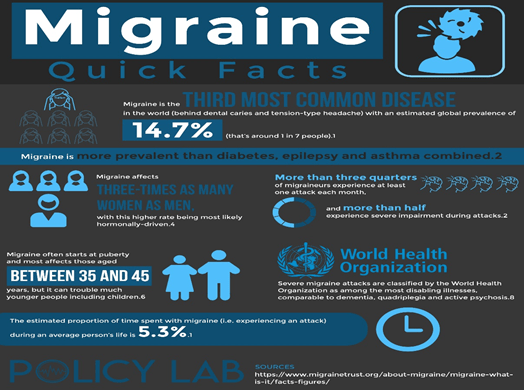
Migraine: not just a headache.


Migraines are occurring more and more in many different people. There is a lot of research and information available, however, many people still think of a migraine as a bad headache. It is much worse than that! I will use my experience to try and dispel this myth.

            Almost all of my attacks don’t start with a headache, that comes much later, usually 3-4 hours after the initial symptoms. Migraines can be split into four parts: prodromal which can start up to two days before the attack; aura, which leads into the third phase the main headache and finally the resolution where recovery begins and feelings of tiredness occur.

            Most of my attacks start with a visual disturbance. This can be a number of ways. A small light, like a hole which grows gradually so vision is difficult. A second way is a flashing coloured circle which, again, grows and moves across my vision, a third, similar way is a ‘c’ shape of coloured light which again grows and moves across my vision. And finally there can be disruption to my sight particularly through one eye where objects can’t be seen clearly, only in part. All of the above make it extremely difficult to see clearly or to focus on anything. At this point I have to go to a darkened area, close my eyes and lie down until I can see clearly again. This usually lasts for around 30 minutes.

            The next stage is a tingling or numbness in the fingers and arm. It can start like ‘pins and needles’ and travel up my arm. This can start anything up to twenty minutes after sight has been restored and can last for around fifteen minutes. Trying  to do anything that needs touch is very difficult and uncomfortable. Occasionally this spreads to the face, in particular the tongue, where it feels swollen.

            After the tingling and numbness comes a feeling of not being able to speak clearly. It appears like slurred speech and sometimes as though not saying words properly. It can also feel like I’m not saying a word at all and at times I find it difficult to get the right word to say. This makes life difficult when in meetings or even trying to have a conversation.

            The final phase of the ‘aura’ affects my memory. I find it difficult to remember names in particular. This has caused problems when speaking to people and not being able to remember their name. So from not being able to talk to someone properly and then not remembering their name, it can all become very embarrassing, annoying , frustrating, and, of course, amusing, when with the right people!

            The whole ‘aura’ can last up to three hours, with a short space of time between each phase. Not every attack follows this pattern or has all of the ‘auras’ described. Most start as visual disturbance. After the ‘aura’ the headache starts.

            The headache can be of different types and in a different place. Pulsating, throbbing or a constant pain. Usually near one eye or on one side of he head. The intensity of the pain also varies. Movement is difficult and painful, sitting still or lying down is the easiest and most comfortable. Do not cough! Patience and concentration are very low. This can last between forty eight and seventy two hours, easing slowly as time goes on.

            As the pain decreases then the resolution phase starts. Many things can happen at this stage. Hunger, especially craving sweet things, biscuits, cakes. Depression, feelings of not being worthwhile or being a burden, and becoming very emotional over the least thing. An intense tiredness, just wanting to sleep and having no energy or motivation to do anything at all.

            Including all four phases, a full attack can last up to five days before being able to do all activities fully. This doesn’t happen every time as every attack is different. However, every attack does affect life. Time at work, with family, doing hobbies and sport are all affected. Trying to do things too soon, not recovering fully also affects me. Many times I have not fully recovered only to have another attack within a few days.

            Trying to predict when an attack will happen is difficult. There are many triggers, but they don’t always lead to an attack. The main triggers for me are anxiety and stress, lack of good quality or interrupted sleep, sometimes food can lead to an attack especially cheese and chocolate. I do have to be careful with oranges. Red wine is also a big trigger. Doing too much exercise with insufficient rest can also start an attack. The strangest triggers are bright sunlight and the colour red! At times I have expected and attack because one or more of the triggers have been present, and nothing occurs. At other times I have felt calm, fit and well and have been surprised by the onset of an attack, leaving me bewildered, confused and upset.

            My first attack happened as a teenager, over forty years ago, and I still remember it clearly. During that time I have tried many things, keeping a diary of attacks, keeping a food diary, many different types of medication – herbal as well as prescribed. Nothing has stopped attacks happening. All have had some effect for some time. There has been nothing that takes away the pain or makes it easier to live with. Medication has included tablets taken daily or at the start of an attack. They haven’t lessened the effect of the attack or stopped it. The only thing that seems to work is to rest, stop doing all the things I enjoy and wait for it to clear. In an ideal world it would be good to lock oneself in a cool, dark room for the duration but, of course, with work, family and other commitments this is not possible. I still record attacks, I use an app called ‘Migraine Buddy,’ this is a  useful app has it also has a lot of information about migraines and tips for how to live with them.  

The fairness of Year 11 students.

The current Year 11 students have had a very bad deal. Their education has been severely disrupted, possibly having serious repercussions on their future. Along with this there is some unfairness in the way they have been educated. What should have been a two year GCSE course has turned into a lottery. This hasn’t been helped by a Government that has done little to help and support them. From late decisions to mind changing at the last minute it is no wonder they could become the lost generation.

The GCSE and BTEC course work should take around five terms to cover, giving some time for pre-exam revision. Of the four and a half terms completed, most Year 11 students will only have had two and a half terms of face to face in school teaching, the rest of the time accessing on-line teaching or work packs sent home. Of these two and a half terms, only the first term and a half could be argued to have been proper curriculum course work teaching. The other term, September 2020 to December 2020, a lot of time would have spent assessing to find out what skills and knowledge had been retained during the first lockdown and summer break, as well as playing catch up to re-teach those skills and knowledge that have been lost. Also during that Autumn term many students were sent home as classmates tested positive, so again having no face to face in school teaching. Another unfairness as not all students were sent home but had to attend school, meaning they had more in school teaching than their peers in the same school.

The quality of teaching and learning during all of the lockdowns and isolation periods will put some students at a further disadvantage. In the first lockdown schools had no real guidance or time to prepare. This meant that many had to ‘make it up as they went’ and were under-resourced. The recent lockdown has seen many schools learning from their mistakes and so produce a much more beneficial and fairer learning experience. But again, they have had to work this out for themselves with little guidance or support from Government.

As yet schools, students and parents are unsure of how grades are going to be awarded. I have heard of three schools all having plans to do this in different ways. It didn’t help that a late decision was made to cancel official GCSE exams in England. Earlier decisions being made in Scotland and Wales meant that their schools could work with the relevant examination boards sooner and have a plan in place much earlier. England, again, playing catch up. However, no matter what method is used, there will be a difference from previous years when students have been taught the full curriculum. So, whatever system is put in place it must recognise this and be fair for all students.

When schools do re-open it is likely that time will again be lost to finding out what stage each student is returning at. This will be made harder as many students may find it difficult to return to school. Those who have problems socialising, are being bullied, isolated or have a SEND and have been in a better mental state at home , may not want to return. On the other hand, some students might have been affected by an increase in on-line bullying, something which their usual support networks or agencies may not have been able to detect.

Looking to their future has also been made more difficult. College and sixth form open days and events have had to be cancelled or replaced with on-line events. These, although informative, can’t replace the face-to-face meetings and college tours. Opportunities to find out relevant information and ask pertinent questions will have been fewer. Students may have been put off by on-line events so missing opportunities to find out the finer details of the course or college itself.

For many families their relationships will have suffered. Constantly checking that their children are on line, in a lesson or completing set work will have a wearing down effect and lead to many discussions and arguments. Children feeling that all their parents are doing is nagging them to complete work, parents feeling that their children are not putting in the required effort. This being compounded by the fact that is Year 11, arguably the most important year. On top of this is the frustration of not knowing how their work will be assessed and grades awarded. As well as the impact this could have long-term, on college and work places, leading to university entrance.

Many parents will have found tutors for their children. This in turn leading to misunderstandings and further discussions, the child not seeing the need, the parents wanting to make sure their child has the best opportunities and doesn’t miss any knowledge or skills. In addition, there will be a cost at a time when many families will be having financial difficulties due to their work and income situation. This further widening the gap between poorer and wealthy families and students.

This last year has been difficult for everyone. The impact of disrupted education and uncertainty over assessments and qualifications, as well as the lack of opportunities to fully investigate future college and work placements has made it more difficult for the current Year 11 students. When schools do finally return then it must be that Year 11 students are treated with a high degree of importance and sympathy. Whatever is decided, the massive disruption to their education now and in the future must be taken into consideration. There must be a fairness for all students, considering the disruptions in different areas as well as how these have been dealt with by different schools and authorities. Not an easy task, but something that must be done if these students are not to become a lost generation. These Year 11 students are the future of the country and need to be dealt with fairly and given a future to look forward to.