More and more drivers are appearing on our roads. All of them should have have passed a two part driving test, at least. That won’t apply to older drivers who only had to drive then answer a few questions. This should mean that today’s drivers are better, safer and more understanding. That is not the case.
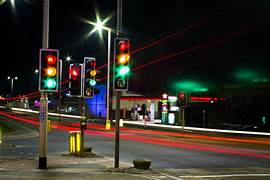
I find that many drivers these days have a problem identifying colours. Something they were taught in pre-school. Maybe it is only difficulty with red, amber and green. A lot of drivers only being able to see green. Unless of course someone does something they don’t like then they see red. I either slow down to stop at the lights, or already stationary traffic, the lights being on red, and cars will pass me ignoring the colours, not only taking their own lives in their hands but those of the drivers and passengers coming the other direction correctly.
Equally annoying are those drivers who bought cars that don’t have indicators. I’m not sure why cars are being manufactured without them, they are an essential part of driving a car safely. They let other drivers and pedestrians know when a vehicle is turning. It seems that a lot of drivers haven’t found where these are located in their car or they’re just not there. I often wait at a junction expecting the car to go straight on as it isn’t indicating, then it turns. Annoying and frustrating.
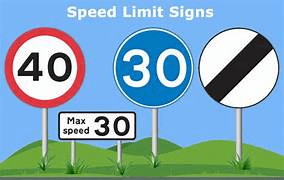
As well as not recognising or knowing colours, which they were taught in school, drivers don’t know their numbers. Maybe it is a school problem, as lots of things that have been taught haven’t been learnt. How numbers? Speed limits.
It is very rare to see a driver following a speed limit, whether this be local roads or dual carriageways and motorways, fixed speeds or temporary ones for works. I get that it can be frustrating driving at 40mph on a dual carriageway in roadworks, but , unfortunately it has to be done. I do wonder if anyone ever gets a speeding fine whether from a police camera, average speed camera or static cameras, as they never seem to deter drivers. Connected to this are those drivers who drive too close. They must not value their lives or vehicles. Too impatient to drive at the correct speed they think that getting close will actually make the other driver go quicker. When it happens to me I drive slower!
Out of courtesy, if someone lets me in a gap or out of a side road, I make the effort to say thank you, either by waving, flashing lights or some other appropriate method of acknowledgement. I will admit that at times I forget, if the traffic is busy or it’s dangerous to do so. But I’m in the minority, finding that if I let other drivers in or out most of the time they just drive off, that is the ones who actually wait. Some drivers think it’s their right to pull in or out wherever and whenever they want.
Despite all of the issue highlighted, there are a lot of good, courteous drivers on our roads. Unfortunately they are becoming harder to find. For everyone’s safety and sanity I hope there will be more.
The way we get our music has changed immensely over the years. When I was growing up in the 60's and 70's, listening to my parent's record (vinyl) collection, it mostly consisted of 12inch 78rpm records, with some 7inch 45 rpm. I bought 7inch 45's as well as 12inch albums at 33rpm. Then there were cassettes. These were easy to take around with you and play in the car or garden. My uncle had something called an 8 track stereo, which was a tape. I neve really understood these, he was the only person I knew who had one. These music methods seemed to work well, apart from getting the vinyl scratched, making it stick or jump and the tape would come out of the cassettes, requiring a handy tool (pencil) to wind it back in. Along came CDs. Hard plastic that, apparently, would never break or scratch and you needed a special CD player on which to play them. Most music produced would be released on a CD. They did look like a small piece of vinyl, As opposed to the 12inch vinyls, CDs only were played on one side. You could listen to a full album without having to get up and turn it over. However they did get scratched and damaged. And the machines to play them on did stop playing them properly, meaning a new player had to be bought. Mini CD players became available meaning they could be carried out and about, and players were installed in cars. Smaller than vinyl albums, they didn't take up as much space, but the cases they came in where a lot wider so you didn't really gain that much space. Then came apple and their ipod range. Different sizes for different occasions and with different sizes. I have one of the big ipods, it has over 160000 sings on. At the time all of my record, cassette and CD collection. Being able to convert vinyl to an ipod wasn't an easy process, and it was time consuming. I also have a smaller Nano which has almost 500 songs on. When my ipod was full I had to get an mP3 player as the ipods I liked were no longer available. Whenever I get any new music, Vinyl, cassette or CD, I immediately put it onto my mP3 player. The biggest advantage of these for me is that I can take my whole music collection with me wherever i go. Now it seems as though streaming is the way. Vinyl is making a come back and CDs are still around. Most Streaming sites charge a fee, usually monthly, for unlimited downloads. However, any downloads only last while you are part of the streaming service, once you leave so does the music. It's a new way, and one that I use but aren't fully aware of. My teenage sons are, and use them for all of their music. As yet I'm not totally convinced, but that may be because I'm old, or so I'm told!! Along with all these methods of listening to music, there has always been radio. Which was the best way to listen to and find new music.
                                                                             Car wash

Washing cars in winter. Is it necessary? Why do it? Isn't it just a waste of time and water?
Cars get really filthy in the winter months. The wet roads, salt and grit everywhere. Spray thrown up by other vehicles. Not to mention the awful weather - wind, rain, snow, ice, frost.
This week I've seen a lot of my neighbours cleaning their cars. What's the point? In no time at all they will be just as filthy and in need of another clean.
However, cleaning the car is better than having to wash my hands every time I get in it or put something in the boot. The handles and locks are so mucky that the merest touch gets body parts and clothing very dirty. No matter how careful I try to be it is impossible to avoid the dirt.
When driving you can spot those owners who take the easy, quick way and only wipe parts  of the car - number plates, boot lid and front and rear windows, but not all of the window. Sometimes a quick squirt of the windscreen washers will suffice but there does come a time when the edges are too dirty to see out of clearly.
It may be an onerous task, cleaning the car, especially in the cold of the winter, but I would rather clean it myself than take it somewhere. I have always felt that for any able bodied person, cleaning the car is something that they should do themselves.
                                                               January.
Lots of my friends tell me that January is the month of the year they least like. It always seems to them to be cold and dark with little to look forward to other than going back to work, especially after having had a Christmas and New Year holiday, full of fun and laughter and family time.
Me. I think the opposite. I quite like January and think it is unfairly thought of. To me it is the time when days begin to stay lighter for longer, so not being as dark as November or December. It also seems as though the year is now turning back towards the summer, the winter always seems as though we are going away from Summer, January turns the corner and brings us back. It is also the time of new hope and, in lots of instances, especially with resolutions, a time to start afresh. We have recharged our batteries over the festive period and are ready, once again to face the world.
                             Holiday.
Christmas holidays are great for family time, if you have a family to spend time with. We only have the four of us close by. Parents are no longer with us and my only sibling, a brother lives away. My wife is an only child. There are cousins but we haven't been in contact with them for a very long time.
Now our two sons are teenagers the time they want to spend with us is getting shorter and becoming more precious. Christmas this year was good. We spent time together, with very little of the usual arguments and disagreements. Games were played with a  lot of fun and laughter instead of the screaming and shouting when not winning, or when Dad wins again. That is the boys not me and my wife. Christmas dinner was also a bit more successful. Food was eaten, not a lot of waste and the turkey actually tasted of turkey and wasn't as dry as it normally is.
                                                                   Work
This is an important year for me as I'm intending to leave teaching after 38 years. This will happen after the Primary SATs in May. It may seem strange to finish then and not at the end of the academic year. I decided to do this in order to take advantage of the cheaper holidays in term time, something I haven't been able to do. My two sons will be on their summer breaks, the oldest from his university course and the younger will have finished his BTEC course work and exams. This was the plan until one of them announced he is planning on going on holiday in June with his friends. Never mind there is always September.
Half term finished. One teenage son back to college for the summer term, the other at home for the summer having finished his first year at university.
What do you do with teenage sons? They don’t want to do anything or go anywhere with their parents, which is fine, I get that, I was the same. But, they don’t seem to want to do anything at all other than stay in and play on a games console, in their case an Xbox. Th e youngest, 16 (almost 17) is the worst, only comes out of his room to shower, which can be 2 or 3 times a day. At least the older one (19) will go to the gym or out on his bike. He has been meeting friends.
This another of those ‘How things have changed’ times. When we were their age we were out on bikes, kicking a ball about in the fields or just sitting out side talking and messing about (safely and without bothering the elderly neighbours). I was working and playing football 2 or 3 times a weekend. Training in mid-week and had a girlfriend. Me and my friends were out in the town at the weekends, in particular Friday nights, Saturday recovering in time to play for the local pub team on Saturday afternoon. Nights out finished around 11pm, occasionally 1am if we decided to go to the nightclub. Nowadays they don’t go out until 11pm, staying out until 3 or 4 in the morning. It’s no wonder they want to sleep or stay in their room all the next day.
Here’s looking forward to the next college holidays. At least they have agreed to come on holiday with us.
End of the first year might seem a strange title, especially as we are in the middle of the year.
It is the end of he first year that my eldest son has been at Uni and the youngest son is almost at the end of his first year at sixth form college.
This time last year me and my wife, were in the middle of A levels and GCSE exams, wondering, and worrying, if they would go the way we wanted for our sons. A stressful time, making sure they were relaxed and calm before the exam and picking up the pieces when they came in feeling as though they hadn’t done the best they could.
Forms were completed and sent to the universities and colleges of their choice along with the courses they wanted to follow. Now it was the waiting, waiting and not being able to do anything, everything out of our control. Looking back, we were probably more worried and concerned than they were.
It all worked out in the end. Our eldest son got the UCAS points he needed, the exact amount! The youngest son passed all of his GCSE exams and so was able to go to the sixth form college of his choice, which is just round the corner, as well as the subjects of his choice. His first year is almost completed. From reports he has done well, but as you can expect with a 17year old who loves his sport more than anything else, he has got through but not fulfilling the massive potential he has, doing enough work to ensure he gets a decent grade rather than the best grade he is capable of getting.
But then next phase started.
The eldest was off to a Uni 50 miles away, So began the worry about whether he would be able to settle, would fit in, would he be safe, would he be homesick, would he make friends, would he find the course work too hard, would he be able to feed himself. Never mind about the washing, keeping clean and getting up in time to get to lectures.
The remainder of the summer was spent making sure he had all the things he needed to take with him: bedding, towels, clothes, plates, cutlery, pots and pans. Excitement for him, uncertainty for us. We tried to hide our fears and be as excited as he was. Difficult at times. Packing the car to take him down was hard, unpacking it at the other end and driving away even harder. Both of us holding our tears back. He’s not one to show or talk about his feelings, so it was hard to gauge what he was thinking or feeling.
And now he has completed his first year. and back home for the summer Due to the nature of the course, dates, work and holidays he has spent quite a lot of time back home. Even so he has surprised us. He has settled better than we expected. Made a whole load of friends. Been successful in all of first year tasks, activities and assignments. Appears to be well liked by other people on his course and by the lecturers. He has learnt a lot but more importantly , has grown into an amazing young man.
So, we will spend the summer with both of them together. Making more memories and hoping the second year will be as successful as this first one has been.
Migraines have been a big part of my life for over 45 years. Nearly always unpredictable, striking without warning. The first sign usually a visual disturbance, flashing lights or blurred vision. Difficult on sunny days or where there are lights, because reflected light hitting the eyes, makes it appear as though an attack is starting, creating another heart stopping moment – not another Migraine!
Recently, April 2022, I found some kind of pattern and relief. From January up to April I had 7 attacks, mostly after exercise. Not immediately, but within a few days. I have always exercised, cycling, swimming, running. So I looked back in order to find something. I noticed that in the past, after exercise, I had usually had a post training drink or fruit, during these recent attacks I hadn’t bothered. But even with this intake my migraines had still occurred, though not as often.
Then quite by chance, I found an article about Magnesium, a lack of which could cause many problems, one of which could be increased, or more severe, migraines. After reading this I checked for foods and supplements that included Magnesium. I found there was a connection between the foods and supplements I hadn’t been taking over the previous months and a lack of Magnesium in my body. As a result I changed my diet to include more Magnesium rich foods and made sure I took something containing Magnesium, either before or after exercise. I also started to take Magnesium tablets ( the ones I am taking also have vitamin B6) daily.
Other influencing factors in my life, such as work and family have also increased in stress and anxiety, which in the past have had an effect on my migraines. However since becoming more aware of Magnesium this doesn’t seem to be affecting me as much. I have been busier at work, causing more stress. Home life has also been busier, teenage boys to get to events, either ones they are participating in through sport, or just through their social life. This in turn affects anxiety levels, as to where they are and who they are with.
I must be aware not to make it sound as though taking more Magnesium is a cure for me. There could be other things going on that I’m unaware of, especially the psychological aspect, ‘it’s supposed to work, so I’ll think its working’. The big test would be if I stopped taking the supplements or cut down my daily intake, but, why would I do that? It seems to be working, my life is improving, migraines have been fewer and not as severe. I’m not going to stop doing what appears to be working in order to test whether it is or not.
Where does Magnesium appear in foods. The Recommended Dietary Amount (RDA) for an adult is; Men19-51+ 400-420 and women 19-51+ 310-320. The tablet supplement I have been taking is 375mg. As this is slightly lower I make sure there is some Magnesium in the food I eat, especially if the day has been busy or stressful, or if I have exercised for a long period.
Prices rise for many reasons, one of them being costs. Including. cost of production, transportation, of materials, of energy in production, and of the worker’s wages.
If any of these costs rise what happens? The producer/provider increases the price of the goods to cover this increase. This is then passed down the line until it reaches the shops where the consumer pays the final price. The consumer stage is the only stage where nothing is added to the price, the consumers are the only ones who lose money as they still have to buy the goods and services they need but with the same amount of money.
The money consumers have, in this model, will increase if they increase their costs through higher wages. They will then have more money to spend, but, in real terms they won’t because the prices in the shops have increased, creating a new equilibrium.
But also, an increase in wages is an increase in costs so … manufactures, producers, providers, retailers, transporters etc will increase their prices to cover this increase in wages. This will then lead to higher prices in the shops.
A price rising spiral !
How can this be stopped?
It would seem that it can only be stopped if costs are not passed on at one or all of the stages. But who would want to lose money? No-one. Ultimately someone has to take a common sense approach and either not raise their prices or, if they do, then by not as much. It should be the responsibility of everyone and everyone should bear the burden, not just the workers.
And so it continues. Sense and decency prevail, the 45% tax rate is re-introduced, but this only gives small returns compared to some of the other tax cuts. But it’s more than just money.
How can anyone justify giving those who have a lot, more than those who have little. And now there’s disagreement about those who have even less, relying on benefits to live, getting enough. Will their money be, in real terms, cut, depending on which rate is used to calculate what they get.
This discussion will, inevitably, bring in comments about benefit cheats. Remember not everyone is a cheat. I suspect there are just as many, if not more, ‘cheats’ getting more money. These include tax cheats and dodgers, those who move their money from country or account to another, in order to avoid various payments, businesses finding loopholes in all of the systems. And then there are the expenses cheats. But the public tend to hear less about these and more about the benefit cheats.
Cheats there may be, as there are in everything involving money, but there are a lot more instances of people and families needing some kind of assistance to help survive from day to day. Obviously there are those suffering from one of the many disabilities which stop them from working or earning an income. There are also people who are trying, and have tried many times, to find work. At present the figures show the number of vacancies is rising, but are these vacancies appropriate? Are they within travelling distance ( a bike ride!)? Will families have to face the upheaval of moving, leaving family, friends and support networks behind? Is the wage fair?
Governments should be looking at how to get people into appropriate jobs where they feel they are worth something, with a wage that they and their families can live on without having to visit food banks, and are close enough so families can stay together in places they know.
Governments, of any political persuasion, theory or doctrine, should not be playing games with people’s lives.
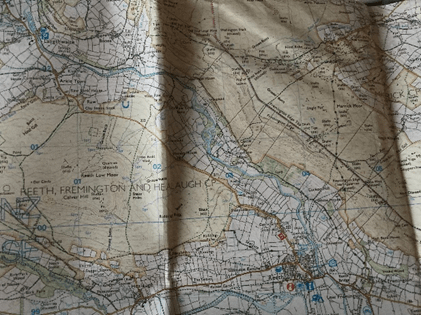
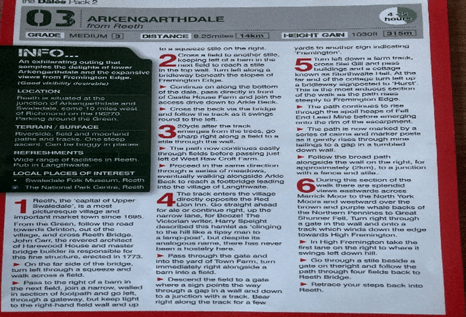
For this walk I used the Yorkshire Dales OL 30 OS explorer map and ’The Dales Pack 2’ walk cards.
This is the third time I’ve completed this walk. The other times, I did one clockwise the other anti-clockwise. On this occasion I decided to go anti-clockwise. The man reason for this was that the climbing and high level part of the walk came at the beginning. I felt it was better to attempt this while I still had the energy rather than in the second half when I was getting tired, but also re-starting after having a lunch break is never easy, and the village of Langthwaite is the natural half way lunchtime point. So, using the ‘Dales Pack’ cards and OL 30 Yorkshire Dales, Wensleydale and Swaledale map I set off from High Fremington. At the end of the walk I stayed on the bridlepath back into High Fremington rather than turning off at a gate down through a field into Reeth as it shows on the Dales pack card.
Today Reeth is the main town in upper Swaledale, but this wasn’t always the case. In Norman times, up until the leadmining times of the 18th and 19 centuries, when Reeth became an important service centre for the mines and smelt mills, it was Grinton, further along the road. Some of the inns and hotels can be traced back to pre-leadmining times.
There is parking in Reeth itself but I was able to find space set back from the road at the edge of Low Fremington, other cars were also parked there, no ‘No Parking’ signs or yellow lines, so I felt settled leaving it. The gives a length of around 8¼ miles and a time of 4-5 hours. With a few photo stops, talking to bike riders and other walkers, and a packed lunch in Langthwaite, I was back at the car in just 4¼ hours.
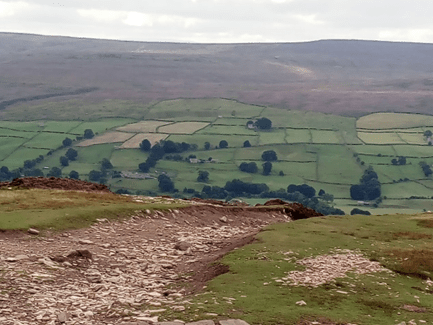
The start is very daunting; steep and difficult underfoot, rising to around 400m. It starts on the road, narrow, tricky and steep up through Fremington. As it reaches houses there is the choice of a steep off road path or stay on the road. I stayed on the road, which turned out to be the better choice as it was smoother going and not as steep. The paths meet at a bridleway. This was the way I returned. Stay on the road as it continues uphill and through Intake Wood. As I walked up this part I was passed by a cyclist and then a car. The car stopped at a house further up the hill, just as the smooth road stops and the rugged, stony path begins. It made me think about how they managed in depths of winter, trying to get up here when the road is covered in snow, or maybe the people there at the moment were using it as a holiday home. At times there was the opportunity to walk on the grass, this came as a big relief from the loose stones and holes in the path.
The tricky uphill path
The tricky uphill path
Looking up ahead, I noticed the cyclist had also found the terrain difficult and had got off his bike and started walking.
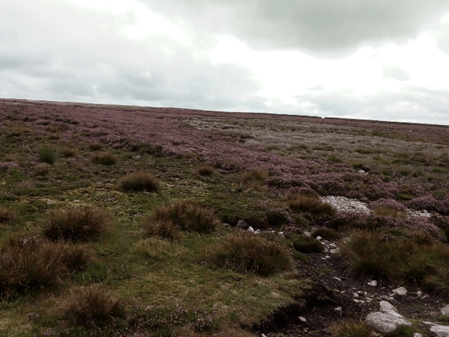
Lonely on the moor top.
Just a few sheep for company.
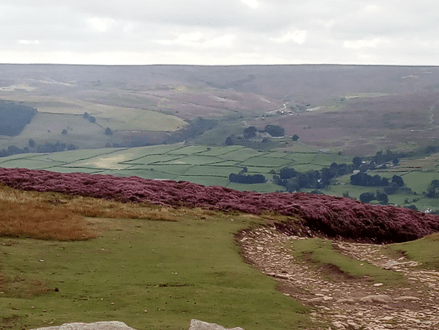
Along the path there are plenty of places in which to stop and take in the view back across the valley beyond Reeth to the fell tops of Reeth Low Moor and Harkerside Moor. These places could also be used as photo opportunities, or, resting places! The man on his bike had stopped in order to make the most of one of these spaces. He was still there when I reached him, so I stopped and had a chat, it would have been rude not to! The bike he was using was rented from the centre in Grinton and motorised. He told me it helped on the smoother parts of the track but was still tricky on the lumpier loose stones. As were talking another cyclist approached, carefully picking his way through, but not stopping. He had an amazing pedalling rhythm and was working hard to maintain it, his eyes fixed on the path. We both looked on in admiration. I made my goodbyes and wished him luck with the remainder of his journey, and continued up the hill, reaching the summit shortly afterwards. At the top there was a gate through a wall, giving the choice of staying in the area I was standing in or walking to the other side of the wall. I decided to go through the gate. For me this seemed the better path as I was able to get really good views back over Reeth again but also across this moor, Marrick moor, towards Helwith and Marske.
Through the gate it is a left turn, following the wall with fells and moors all around, only sheep for company. However, on the other side of the wall there were some groups of walkers making their way towards the hill I had just climbed. Along this path, a walk of around a mile, with spectacular scenery all around, until breaking off left through a gate towards the spoil heaps left from the old lead mines. It is thought that at one time this area was producing 10% of the country’s lead. The history of lead mining in this area can be traced back to the 2nd century BC and reached its peak during the 18th and 19th centuries.
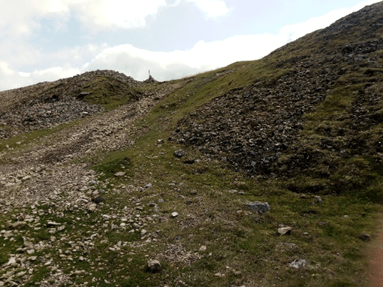
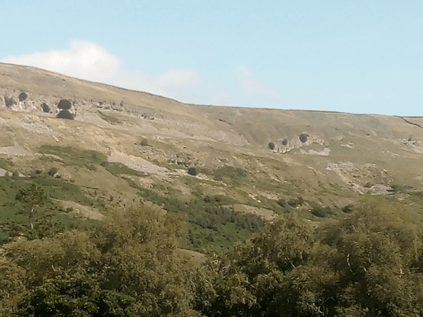
Down through the lead mining spoil heaps.
Looking up onto the moortop.
The path is now much wider, and downhill, with the village of Langthwaite in the valley bottom. About halfway down the path takes another left turn, giving the opportunity to look back across the valley to Reeth, now in the distance. From here the path follows the bottom of the cliff, becoming narrower with loose stones underfoot. It emerges at Storthwaite Hall, which, in the early 19th century was a small hamlet in the township and Parish of Reeth. Then over the stream, take a right and, after a few yards, left, back uphill, through a field towards the small settlement of Booze, described as, ‘clinging to the hill like a tipsy man to a lamp-post’ by the Victorian writer Harry Speight. The path goes through a farm then joins a smooth road, the smoothest part of the whole walk! The road goes all the way downhill into Langthwaite. Just after leaving the farm I stopped to watch a kestrel flying close by, eventually landing on a telegraph pole, watching me watching it. So, another descent. I much prefer going uphill, I find descending, regardless of the surface, trickier, especially on the front of the thighs and knees. The entry into the village at he bottom is very steep. I had already decided that I would have lunch in Langthwaite, so, with aching thighs I was glad to find a bench next to the river, and have lunch.
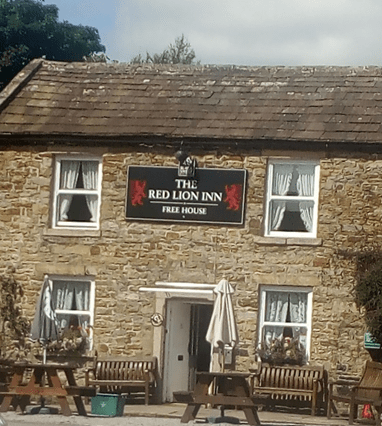
The Red Lion Inn at Langthwaite.
Langthwaite is one of the Yorkshire Dales’ lesser known hamlets, a few miles north of Reeth. Its name is old Norse for ‘long meadow or clearing’, which seems accurate as the small settlement hugs the beck after the wild moor. The Red Lion inn was often seen in the original ‘All creatures great and small’ tv series along with the bridge that leads into the hamlet. It would have been a lot busier during the lead mining times.
It was also the end of the first half of the walk and where the change in landscape started. The first half was high level fell and moorland, with spectacular views across them and into the valleys. The second half was to be low level along the valley following Arkle Beck. Views would be mainly of the fields, over and back up to Fremington Edge, looking at the way I had walked. It was surprising how high it looked from down in the valley bottom. I was able to pick out landmarks from where I had been walking earlier. I also got a different perspective of the spoil heaps and how they had altered the landscape.
After a fifteen minute rest for a sandwich and drink, I started out again, following Arkle Beck away from Langthwaite. It is a walk down another stony path until reaching a bridge, a very narrow bridge, one foot at a time to cross. Looking up and down the beck it is dark as the trees almost meet in the middle, letting little light through. Across the bridge, then left and follow a very narrow path alongside the beck, being careful not to trip over the many tree roots sticking out. The river wasn’t deep but I couldn’t see any fish swimming, they’d probably seen me first. The path eventually leaves the riverside and goes across fields. From the fields, through the trees, it is possible to see Fremington Edge very clearly, and the route I took, seeing the face of the hills. This section continued across a series of fields until it eventually meets a narrow lane.
At the lane turn left and back down to the river through a gate. After the gate, following the road to another bridge crossing the river. This bridge is much wider than the one back in Langthwaite, but the views up and down the river are just as interesting, but not as dark! Crossing the bridge the road goes through another gate and uphill, the longest and steepest, climb of this second half of the walk. It widens as it heads up to castle Farm. Bringing me back to the reality of the day was a sign on the gate to the farm at the top of the hill, telling walkers to go round the farmhouse instead of following the path through as the people living there were isolating from the COVID pandemic!
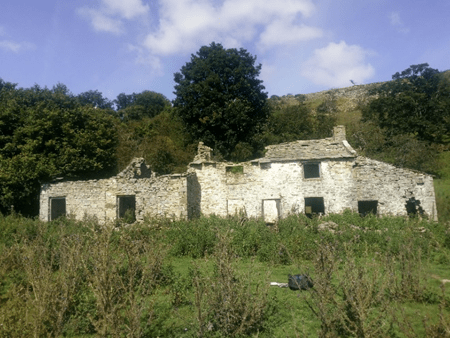
What is the story that goes with this house?
After going round the farmhouse the path is now above Arkle Beck and moving further away from it, going through fields and only slightly undulating. Passing through one of the fields, I notice a very interesting ruin, which certainly gets the imagination working overtime. It is a farmhouse, almost all intact, the doors and windows can be made out easily, as can the gar den gate and path. Inside, the buildings are overgrown and the only inhabitants are sheep, unless at night the ghosts of the families that lived there re-appear! With those thoughts in my head I quickly moved on.
From here the path continues to twist and turn with ups and downs, slippy in places where the sun hasn’t dried up the patches of mud. It eventually comes out onto a bridleway. The walk on the card turns right through a series of fields, some with cows in, a sign warning walkers about this. I had already decided to continue on the bridleway as it meets the steep stony path I walked up at the start. This path stays on the same level, is grassy and wide. From here the village of Reeth comes back into view. It also runs parallel with the road out of Reeth to Fremington where I had parked the car and started the walk. As well as looking down onto Reeth I could look up and follow the path I had climbed three and a half hours earlier.
Reaching the end of the bridleway, returning to the road, I had those mixed feelings, knowing that all the hard walking was done and I could look forward to a rest, drink and hot shower, but also knowing it was back to reality, my escape into the country, peace and quiet, over. From here it was back down the road. I decided to take the narrow path between the houses, the one I ignored at the start. This was steep, very slippy and uneven. I was pleased I hadn’t walked up it earlier. At the bottom it was onto the road, down the hill and back to the car.
There are places to eat and drink in Reeth ranging from tearooms to pubs and hotels. Eleven miles further away is the larger town of Richmond with a wider variety of eating and drinking places, however it would be a shame not to experience fully this jewel in the heart of Swaledale.
A walk taken from ‘AA 50 Walks in North Yorkshire.’ This is walk number 22. I also used the OS landranger map 93.
The walk is a mixture of road, bridleway and footpath. It goes through woodland, moor and fields. It is undulating with two steep climbs and descents. Throughout there are amazing views over moorland and it follows part of the Cleveland Way.
On the day I walked the weather was a mixture of cloud, some short showers with sunny spells. The book gives a minimum time of 3 hours, other than stopping to take a few photographs and a slight unexpected detour (I missed a footpath sign!) I managed to complete it in just under the 3 hours.
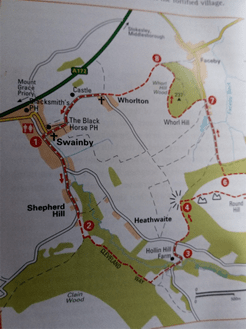
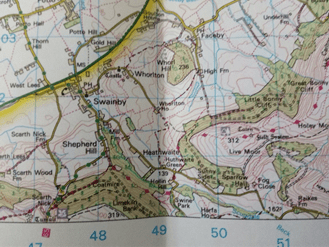
The walk starts and finishes in Swainby, North Yorkshire. A small village just off the A172 near to Stokesley and Middlesbrough. Along the way it passes near two other villages, Faceby and Whorlton. Parking is on the roadside but there are plenty of available spaces and it is free.
Swainby emerged as a village after the Black Death of the 14th Century when the villagers of nearby Whorlton left to excape the disease. It then grew with the influx of workers to the ironstone mines in Scugdale during the 19th Century as well as the jet mining on Whorl Hill. All that remains at Whorlton is the castle and church, both partly in ruin. Faceby was mainly an agricultural area and part of the Parish of Whorlton. Its name could originate from the old Norse meaning ‘Feit’s settlement.’ There is a 12th Century church, St Mary Magdeline.
When leaving the village walk with the stream on your left, along the raod towards the hills. This starts to go uphill, before it gets too steep take a path going slightly left towards Clain woods. There was tree felling, clearing parts of the wood near the path. These were clearly signed making it safe. It also helped as the path I needed could have been easily missed. This is a narrow path leading through the woods following the Cleveland Way.
Through the trees there are clear views . Along this path I met another walker, going the opposie direction, two dog walkers and two young lads running. A busy morning! The path was a little muddy, there having been a lot of rain the previous day. It was also slightly undulating, but nothing too strenuous or difficult.
You leave this path through a gate just past a bench. It goes downhill through a field. I did notice signs warning me of a bull in the field. I could see the cattle at the far end of the field, far enough away for them not to notice me. However, I did still play the game of, “Which one is the bull?” as well as checking the field for the quickest escape route when it does see me.
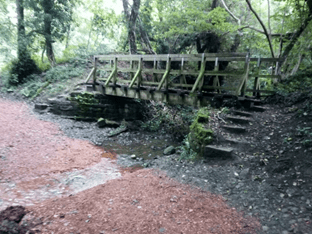
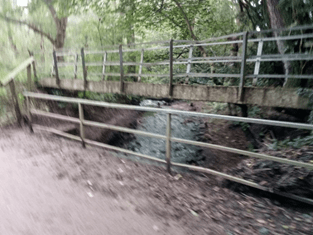
Leaving the field at the bottom corner, I came out at Scugdale Beck with two bridges going over it and joined the road. This area is sheltered and hidden in the trees, and very scenic!
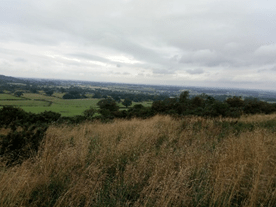
The walk follows the road past Hollin Hill farm to a ‘T’ junction at Husthwaite Green. Cross over the road back into the woods. This is the start of a long, and at times, steep climb. It is a mixture of path and steps. As it goes up there is an amazing view looking back towards Swainby and beyond, the traffic on the nearby A172 and A19 looking like toy cars.
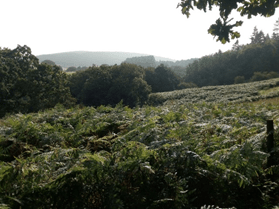
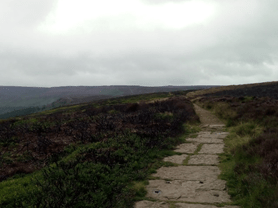
After the viewpoint it is steep walk up through the woods. Continue through a gate and up to the moor top following the path flanked by bracken. This path goes up over 300m, looking down onto the woods of Little Bonny Cliff and Great Bonny Cliff.
West Bilsdale East Bilsdale
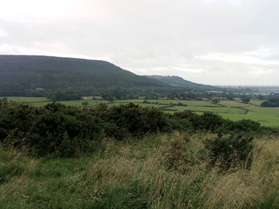
Emerging out of the woods and bracken and across the heather, past two cairns finally reaching the top there are views to the west, again back to Swainby and beyond but also to the east and Bilsdale. A chance to see the contrast between the hills and moors on the eastern side and the fields, roads and villages to the west. Along the path comes the next potential missed turn.
Looking for a small path on the left to take me down back through the heather and bracken to the edge of Little Bonny cliff woods. Luckily I found it rather more easily than I expected. Take the path down to the edge of the woods, this is much easier as you can’t go any further when you reeach the woods. Turn left at the fence and follow it, and the edge of the woods, until reaching a gate. Walking along this path as if walking to the path that took me up to the top of the moor, in a small circle. I couldn’t help wondering why I’d climbed all the way to the top to just come back down and round! It’s a walker’s thing!
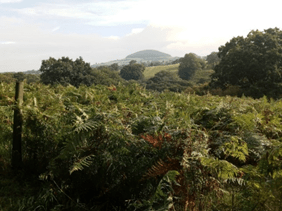
After going through the gate the path falls steeply downhill. This is a tricky descent through the trees, the path being muddy and slippy, and having to negotiate tree roots and fallen branches. Once at the bottom its throught the gate and down the wide path walking away from the woods and on towards Faceby at the bottom of Whorl Hill. Whorl Hill is easily recognisable by its dome shape, standing away from the main hills and woods. Legend has it that the hill is the home of a wyrm dragon which had toxic breath and breathed fire, regulalarly flying across and destroying the farmland and crops. The way to keep it calm and quiet was to feed it the milk of nine cows each day. It was eventually slain by a knight who was passing through Whorlton. His name was never discovered and, to this day, is known as the unknown knight!
This is the part of the walk where I made my biggest mistake, missing the footpath to take me into Whorl Wood. Thinking it was in the village of Faceby I walked straight past it, distracted by (my excuse!) a farmer cutting his hedges! After wandering round Faceby for around 15 minutes I decided to re-trace my steps back towards the woods where, as it said quite clearly in the book, I found the ‘First house on the left!’
This path leads to the next and final steep climb. It goes straight up through the woods keeping their edge on the left. It is a tricky, but short climb that heads off onto a wide path through the woods, with occasional glimpses through the trees back across the moor.
Walk through the woods unitl the path comes to a ‘T’ junction then turn left, this path going back downhill, reaching a further path and passing through a pair of gates. As you follow this path you begin to see the church and castle of Whorlton.
In the distance,Whorlton Church and castle
Whorlton Church dates back to the 12th Century. It is dedicated to the Holy Cross and was known as the Church of the Holy Rood up to the Reformation. Inside is a large oak effigy of Lord Nicholas de Meynell of Whorlton Castle who died in 1322. The church was used for the last time on 7th March 1875 although occasional services are still held there. The castle, just along from the church, was probably built by Robert de Meynell around the 12th century and was an earth and timber Motte and Bailey. By the mid 14th Century it had fallen into disrepair and was demolished, being rebuilt with a new stone tower and fortified gatehouse, this being all that remains today.
During the 19th Century large amounts of stone were removed and used to build Swainby village church.
The path continues past a farm and through fields. It was particularly tricky as a lot of nettles were beginning to stray onto the path. Wearing shorts turned it into a game of trying to avoid the nettle sting! Thankfully I got through unscathed. This is the last of the footpaths as you reach the road at Whorlton church then it is roads all the way back past the church and castle, into Swainby. Unless, like I did, take a small path on the edge of the village which takes you round the back of the cottages, past a playing area and emerges at the Black Horse pub. If you stay on the road you get to see more of the village, in particular the old school house. The buildings along Church Lane are very interesting, not least Holy Cross Church at the end of the lane.
After the walk refreshments can be taken in the Black horse pub as well as the Rusty Bike café. Swainby has easy access to the A172 and A19 making it easy to get to and get away from. All in all a very enjoyable walk covering different terrain and amazing views over wood, moor and fields. It is steeped in history especially Whorlton.