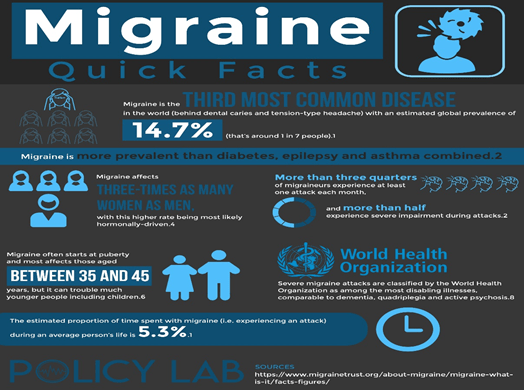
Migraine: not just a headache.


Migraines are occurring more and more in many different people. There is a lot of research and information available, however, many people still think of a migraine as a bad headache. It is much worse than that! I will use my experience to try and dispel this myth.

            Almost all of my attacks don’t start with a headache, that comes much later, usually 3-4 hours after the initial symptoms. Migraines can be split into four parts: prodromal which can start up to two days before the attack; aura, which leads into the third phase the main headache and finally the resolution where recovery begins and feelings of tiredness occur.

            Most of my attacks start with a visual disturbance. This can be a number of ways. A small light, like a hole which grows gradually so vision is difficult. A second way is a flashing coloured circle which, again, grows and moves across my vision, a third, similar way is a ‘c’ shape of coloured light which again grows and moves across my vision. And finally there can be disruption to my sight particularly through one eye where objects can’t be seen clearly, only in part. All of the above make it extremely difficult to see clearly or to focus on anything. At this point I have to go to a darkened area, close my eyes and lie down until I can see clearly again. This usually lasts for around 30 minutes.

            The next stage is a tingling or numbness in the fingers and arm. It can start like ‘pins and needles’ and travel up my arm. This can start anything up to twenty minutes after sight has been restored and can last for around fifteen minutes. Trying  to do anything that needs touch is very difficult and uncomfortable. Occasionally this spreads to the face, in particular the tongue, where it feels swollen.

            After the tingling and numbness comes a feeling of not being able to speak clearly. It appears like slurred speech and sometimes as though not saying words properly. It can also feel like I’m not saying a word at all and at times I find it difficult to get the right word to say. This makes life difficult when in meetings or even trying to have a conversation.

            The final phase of the ‘aura’ affects my memory. I find it difficult to remember names in particular. This has caused problems when speaking to people and not being able to remember their name. So from not being able to talk to someone properly and then not remembering their name, it can all become very embarrassing, annoying , frustrating, and, of course, amusing, when with the right people!

            The whole ‘aura’ can last up to three hours, with a short space of time between each phase. Not every attack follows this pattern or has all of the ‘auras’ described. Most start as visual disturbance. After the ‘aura’ the headache starts.

            The headache can be of different types and in a different place. Pulsating, throbbing or a constant pain. Usually near one eye or on one side of he head. The intensity of the pain also varies. Movement is difficult and painful, sitting still or lying down is the easiest and most comfortable. Do not cough! Patience and concentration are very low. This can last between forty eight and seventy two hours, easing slowly as time goes on.

            As the pain decreases then the resolution phase starts. Many things can happen at this stage. Hunger, especially craving sweet things, biscuits, cakes. Depression, feelings of not being worthwhile or being a burden, and becoming very emotional over the least thing. An intense tiredness, just wanting to sleep and having no energy or motivation to do anything at all.

            Including all four phases, a full attack can last up to five days before being able to do all activities fully. This doesn’t happen every time as every attack is different. However, every attack does affect life. Time at work, with family, doing hobbies and sport are all affected. Trying to do things too soon, not recovering fully also affects me. Many times I have not fully recovered only to have another attack within a few days.

            Trying to predict when an attack will happen is difficult. There are many triggers, but they don’t always lead to an attack. The main triggers for me are anxiety and stress, lack of good quality or interrupted sleep, sometimes food can lead to an attack especially cheese and chocolate. I do have to be careful with oranges. Red wine is also a big trigger. Doing too much exercise with insufficient rest can also start an attack. The strangest triggers are bright sunlight and the colour red! At times I have expected and attack because one or more of the triggers have been present, and nothing occurs. At other times I have felt calm, fit and well and have been surprised by the onset of an attack, leaving me bewildered, confused and upset.

            My first attack happened as a teenager, over forty years ago, and I still remember it clearly. During that time I have tried many things, keeping a diary of attacks, keeping a food diary, many different types of medication – herbal as well as prescribed. Nothing has stopped attacks happening. All have had some effect for some time. There has been nothing that takes away the pain or makes it easier to live with. Medication has included tablets taken daily or at the start of an attack. They haven’t lessened the effect of the attack or stopped it. The only thing that seems to work is to rest, stop doing all the things I enjoy and wait for it to clear. In an ideal world it would be good to lock oneself in a cool, dark room for the duration but, of course, with work, family and other commitments this is not possible. I still record attacks, I use an app called ‘Migraine Buddy,’ this is a  useful app has it also has a lot of information about migraines and tips for how to live with them.  

The fairness of Year 11 students.

The current Year 11 students have had a very bad deal. Their education has been severely disrupted, possibly having serious repercussions on their future. Along with this there is some unfairness in the way they have been educated. What should have been a two year GCSE course has turned into a lottery. This hasn’t been helped by a Government that has done little to help and support them. From late decisions to mind changing at the last minute it is no wonder they could become the lost generation.

The GCSE and BTEC course work should take around five terms to cover, giving some time for pre-exam revision. Of the four and a half terms completed, most Year 11 students will only have had two and a half terms of face to face in school teaching, the rest of the time accessing on-line teaching or work packs sent home. Of these two and a half terms, only the first term and a half could be argued to have been proper curriculum course work teaching. The other term, September 2020 to December 2020, a lot of time would have spent assessing to find out what skills and knowledge had been retained during the first lockdown and summer break, as well as playing catch up to re-teach those skills and knowledge that have been lost. Also during that Autumn term many students were sent home as classmates tested positive, so again having no face to face in school teaching. Another unfairness as not all students were sent home but had to attend school, meaning they had more in school teaching than their peers in the same school.

The quality of teaching and learning during all of the lockdowns and isolation periods will put some students at a further disadvantage. In the first lockdown schools had no real guidance or time to prepare. This meant that many had to ‘make it up as they went’ and were under-resourced. The recent lockdown has seen many schools learning from their mistakes and so produce a much more beneficial and fairer learning experience. But again, they have had to work this out for themselves with little guidance or support from Government.

As yet schools, students and parents are unsure of how grades are going to be awarded. I have heard of three schools all having plans to do this in different ways. It didn’t help that a late decision was made to cancel official GCSE exams in England. Earlier decisions being made in Scotland and Wales meant that their schools could work with the relevant examination boards sooner and have a plan in place much earlier. England, again, playing catch up. However, no matter what method is used, there will be a difference from previous years when students have been taught the full curriculum. So, whatever system is put in place it must recognise this and be fair for all students.

When schools do re-open it is likely that time will again be lost to finding out what stage each student is returning at. This will be made harder as many students may find it difficult to return to school. Those who have problems socialising, are being bullied, isolated or have a SEND and have been in a better mental state at home , may not want to return. On the other hand, some students might have been affected by an increase in on-line bullying, something which their usual support networks or agencies may not have been able to detect.

Looking to their future has also been made more difficult. College and sixth form open days and events have had to be cancelled or replaced with on-line events. These, although informative, can’t replace the face-to-face meetings and college tours. Opportunities to find out relevant information and ask pertinent questions will have been fewer. Students may have been put off by on-line events so missing opportunities to find out the finer details of the course or college itself.

For many families their relationships will have suffered. Constantly checking that their children are on line, in a lesson or completing set work will have a wearing down effect and lead to many discussions and arguments. Children feeling that all their parents are doing is nagging them to complete work, parents feeling that their children are not putting in the required effort. This being compounded by the fact that is Year 11, arguably the most important year. On top of this is the frustration of not knowing how their work will be assessed and grades awarded. As well as the impact this could have long-term, on college and work places, leading to university entrance.

Many parents will have found tutors for their children. This in turn leading to misunderstandings and further discussions, the child not seeing the need, the parents wanting to make sure their child has the best opportunities and doesn’t miss any knowledge or skills. In addition, there will be a cost at a time when many families will be having financial difficulties due to their work and income situation. This further widening the gap between poorer and wealthy families and students.

This last year has been difficult for everyone. The impact of disrupted education and uncertainty over assessments and qualifications, as well as the lack of opportunities to fully investigate future college and work placements has made it more difficult for the current Year 11 students. When schools do finally return then it must be that Year 11 students are treated with a high degree of importance and sympathy. Whatever is decided, the massive disruption to their education now and in the future must be taken into consideration. There must be a fairness for all students, considering the disruptions in different areas as well as how these have been dealt with by different schools and authorities. Not an easy task, but something that must be done if these students are not to become a lost generation. These Year 11 students are the future of the country and need to be dealt with fairly and given a future to look forward to.